Bao’s Top 10 Must-Have, You-Need, Shut-Up-and-Get Cookbooks

Featured

Though over the past year or so I’ve tried to explore cookery via my own instincts — sometimes to great success, and sometimes to dismal failure — it’s no secret that most of my culinary knowledge hails from cookbooks.  Recently, during a bout of procrastination, I decided to tally the number of cookbooks I possess and to my surprise, the figure lies somewhere around eighty.  I’m not sure whether that’s high or low for a home cook (I happen to know Nigella Lawson has several thousand, but she’s a few decades and several billion pounds sterling ahead of me), but in my circle it makes me something of a cookbook authority, I suppose, and over the past year many people have come to me asking what books they “need.”

While everyone’s cookery goals are personal and my recommendations might vary, I’ve compiled a list of my top ten cookbooks.  So read on, buy on, cook on!  It’s a countdown, kids, so get excited.
Continue reading

Les Lentilles, J’Adore

Featured

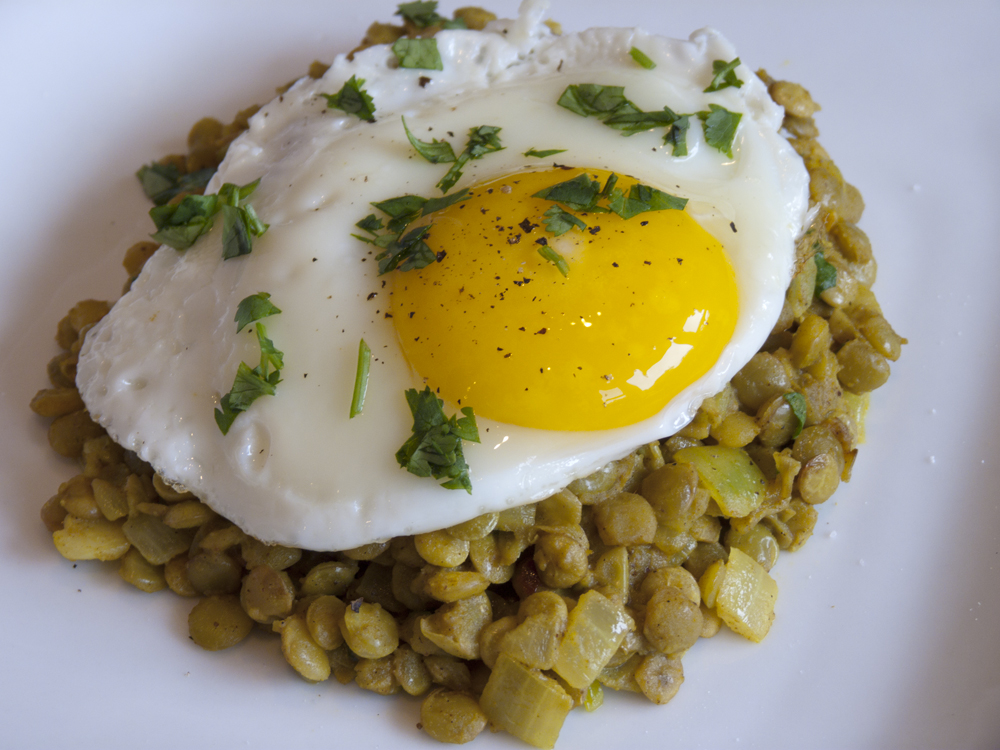
Curried Lentils and EggsA few months ago I started an affair, the passion of which shows no sign of fading.  My partner is the lentil, a sassy little pulse delicious in any incarnation, be it brown or green or red.  Don’t get me wrong; it’s not that I’ve discovered the lentil only recently.  We’ve been acquainted for years.  It’s more like growing up and suddenly realizing that your childhood friend is hot as hell and you are, in fact, in love with them.  So yes, my lentils, I love you.

I suppose that the big revelation came when I made salmon and lentils for myself a month or so ago, with the lentils dressed in a mustard and lemon butter.  It was pure sex, so much so that I insisted on making it for my friends (which led to what I like to call ‘LentilQuest 2010’ — a tumultuous traipsing around Rockville, Maryland to find the perfect lentil).  Despite having gorged myself on fried pickles at Hooters, which is a story for another time, I cleaned my plate — a rare occurrence for moi.

In any case, I eat lentils on an almost daily basis, either prepared simply, or jazzed up in some fashion.  Yesterday, for example, I decided to have lentils for breakfast, and since Matt and I love Indian flavors (nothing is better than garam masala, dudes), the following recipe was born.  You can serve the lentils alone, but I cannot imagine anything better than a fried egg on top, with the yolk oozing down…

Curried Lentils and Eggs

Continue reading

Demystifying the East: The Japanese Holy Trinity

Featured

I’m fairly certain that over the course of my illustrious career, I’ve written, read, and laughed at at least one hundred papers that began with “Demystifying the East” and ended with bullshit.  Misery loves company, so here’s one on cookery.

I was craving Asian food something fierce last night, and came across this recipe for lettuce wraps, the kind one might drop thirteen buckeroos on at PF Chang’s, at the Food Network website.  While I greatly enjoy the combo of hot, intensely-flavored meat against the refreshing, crispy texture of a lettuce leaf I’m not very inclined to sell a kidney for it, especially when most Asian food can be created (or rather, most food can be made to taste Asian) at home for pennies, as long as you know the flavor profiles.  Easy-peasy, right?

Apparently not so for Sunny Anderson, who created the aforementioned lettuce wrap recipe above.  It was at once heavy (from the beef) and way too spicy; the sheer amount of heat from the garlic and red pepper flakes overpowered the sweetness of the hoisin, which should have been providing a foil against the saltiness of the soy and peanuts.  Inedible?  No, it was decent (I polished off leftovers for lunch), but I am an Asian food snob of the highest degree and this meal was definitely not a star (I’ve adapted Sunny’s recipe to be better; check it out here).

After dinner, I found myself asking the little voices in my head, “Do Americans really not know how to do light, tasty Asian?”

They don’t, really.  So let me teach you.
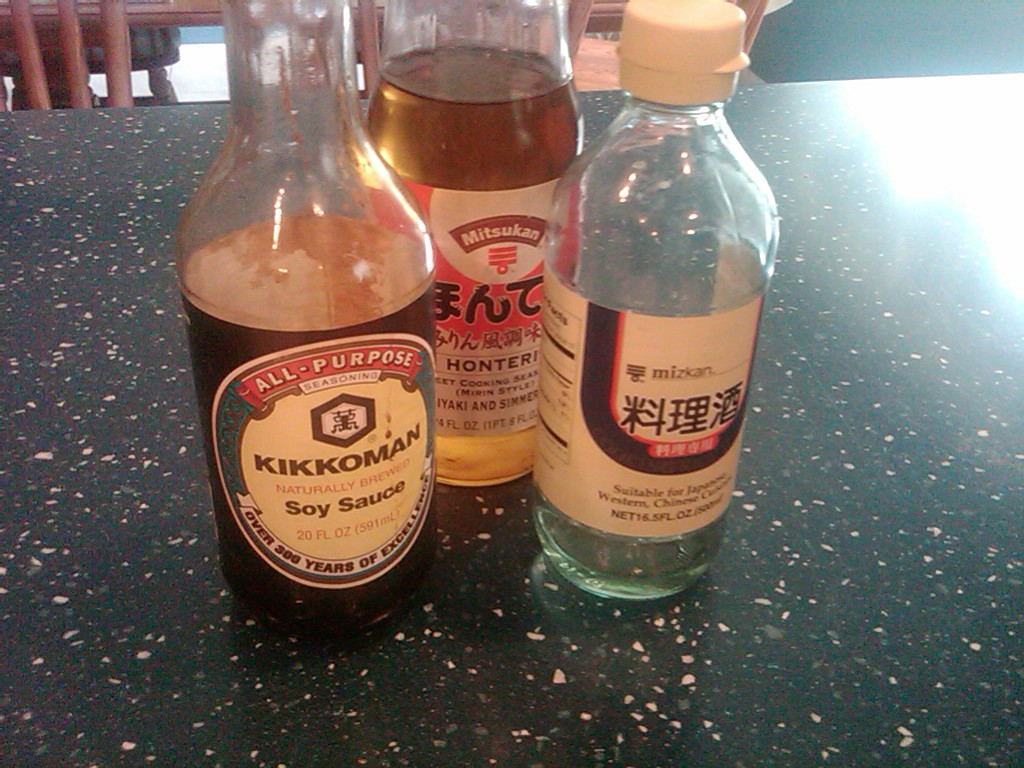
Soy sauce, mirin, and sake -- the Japanese holy trinity of cooking.

Behold the Japanese Holy Trinity of Flavor:  soy sauce, mirin, and sake.  With these three tools, you can make anything taste deliciously light and Asian with minimal effort.  Let’s take a moment and think about each in turn.

Soy Sauce. It’s the hooker of Asian cuisine; it’s cheap, gets you off in a hurry, and you can find it anywhere.  Total bang for your buck.  The pungency comes from the fermented soy beans used to make it, and the high levels of salt added to it during its creation make it a great base flavor to any dish, Asian or not.  This is where that new-fangled Japanese loanword “umami” comes in.

Lots of people get ‘low-sodium soy sauce,’ and these people need to be punched in the face.  Soy sauce is meant to be salty; it is salt for all intents and purposes.  If you’re using it in cooking, don’t add salt.  If you’re using it on the side, don’t drink the bottle.  If you’re worried about your sodium intake, stop eating so many goddamned processed foods.

A final note on soy:  buy Japanese, such as Kikkoman.  Chinese soy sauce is cheaper, but so is the flavor.

Mirin.  Ah, lovely, lovely mirin.  Mirin is a rice wine that has been sweetened with sugar (a great, great deal of sugar), which produces a velvety, almost syrupy consistency.  When you combine mirin and soy sauce with some sugar, you get teriyaki sauce (yes, it’s that easy).

Mirin comes in several forms nowadays; the two I use are “real” (hon) mirin, which is alcoholic, or “mirin-fu chomiryo” (みりん風調味料), which is actually pictured above.  The latter means “mirin-styled seasoning,” and this is because it tastes like mirin, but doesn’t have any alcohol.  Both are acceptable to use, and since I often add sake to my dishes anyway, I don’t miss the alcohol when using the fake stuff.

Sake.  You should all be pretty familiar with sake; it’s Japanese rice wine.  I buy cooking rice wine, though you could always substitute nicer sake if you have it to hand.  This gives any dish some earthy, astringent notes that beautifully mellows out the sweetness of mirin and the saltiness of soy.  It brings balance to the trinity.  (I sound like I’m doing a tarot card reading.)  I like to finish off stir-fries and sautes with sake, adding it at the end and letting it cook out for thirty seconds to a minute.

—-

So now you know the basics.  But what do you do with them?  Try these:

Teriyaki Sauce

3 tbsp soy sauce
3 tbsp mirin
3 tbsp sake
3 tbsp sugar

Whisk together.  You’ve got teriyaki sauce.  Cook anything you want in a pan — meatballs, burgers, chicken breast, fish, tofu, etc.  When cooked, remove said meat, pour in the sauce and reduce over high heat until it’s thickened nicely.  Return meat to the pan, until the goods are thoroughly coated and glossy (do not burn the glaze).  Voila.

Basic Soy Broth

2 cups dashi (Japanese fish or seaweed stock; I use instant)
2 tbsp soy sauce
1 tbsp mirin
1 tbsp sake

Combine ingredients and heat it up.  Can be used to simmer chicken meatballs or poach fish, or as a broth base for ramen.

Japanese Omelet

2 eggs
1 tsp soy sauce
1 tsp mirin

Whisk together and make cook the eggs into an omelet however you fancy.  You’ll have a lightly sweetened, delicious Japanese egg dish.

—-

So there are three super-quick recipes that create authentic Japanese results.  If you just feel like experimenting, play with one or a combination of the flavors at different ratios.  I add soy sauce to pasta sauces and chilis, use mirin in salad dressings, and deglaze with cooking sake instead of white wine.

GG, GIADA! Bao FTW

I’m a pretty big fan of Giada de Laurentiis; in addition to learning a heckuva lot about Italian cookery from her, she’s just a big sweetheart.  Anyways — lazy cookery mode in still in full swing — I was thinking about what to make for dins tonight without taking up too much time (there’s Diablo III to play) and WHAMO! a pasta craving hit me.

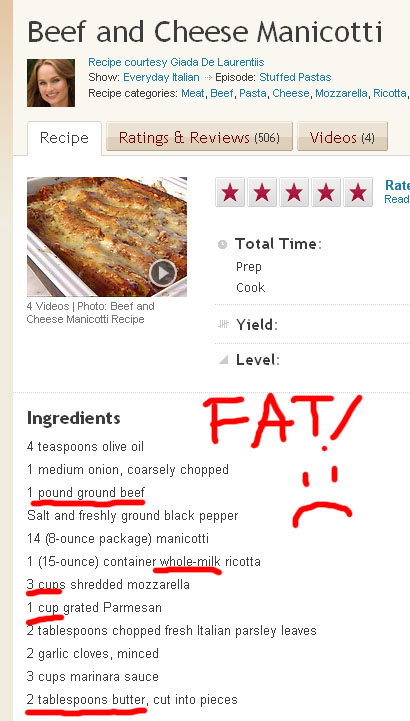
I haven’t made stuffed manicotti in years, and was pottering about online for ideas when I came across a recipe of Giada’s.  I’m pretty sure I’ve made it before, but looking at the ingredients now, I’m shocked by the FAT content there must be in this recipe — FAT that I don’t particularly think adds any flavor.  We all want to enjoy full-flavored food (FFF), but this just sounds unnecessarily heavy and not that tasty.  So I’ve decided to fix it.

Giada's FAT Beef and Cheese Manicotti

Continue reading

For the Honor of Lazy, or a Simple Dinner

UGH!  I am the absolute worst about posting updates to this blog despite my good intentions; I mean, my kimchi post is DONE and waiting to be uploaded but I’ve been too lazy to grab the photos off my camera!  I am shameless!

In honor of that laziness, today I’m posting a pretty basic recipe that I like to do on weeknights (sans pictures, of course, which kind of makes for a crappy blog, but oh well). I generally use pork with it, but it can be used with chicken breasts or even salmon.  And heck, if you don’t have tarragon, use thyme; if you don’t have vermouth, use white wine or all chicken stock.  I like to serve this with some green beans and some crusty bread, which, you can imagine, is the perfect utensil for mopping up the extra sauce (as this recipe provides more than you will possibly need).

Sauteed Pork Chops with Tarragon and Mustard Sauce
Serves  4.

4 boneless pork chops, about 3/4″ thick
Kosher salt and freshly ground black pepper
2 tbsp olive oil
2 tbsp unsalted butter
1 bunch scallions, white and pale green parts, chopped
pinch crushed red pepper flakes
1/2 tsp dried tarragon
1 glove garlic, finely minced or grated
1/4 cup dry vermouth
1/2 cup chicken stock, preferably homemade
1/2 cup heavy cream
1/4 cup good Dijon mustard
1 tsp good stone-ground mustard
2 tsp chopped fresh tarragon

Heat the olive oil in a large skillet over medium-high heat.  Pat the pork chops dry with a paper towel, and sprinkle the tops with black pepper and then the salt, generously.  Once the pan has come to heat (the oil should be shimmering slightly, but not smoking), place the chops in, seasoned side down.  They should sizzle.  Season the exposed side of the chops and cook until both sides are browned, about 3-4 minutes per side.  Remove the chops to a plate.

Ditch the oil from the pan, lower the heat to medium, and add the butter, chopped scallions, red pepper flakes, dried tarragon, and a sprinkle of salt.  Cook for five minutes, stirring occasionally, until the scallions have softened and the tarragon is very fragrant.  Add the garlic and cook, stirring, for about 30 seconds.

Pour in the vermouth and let it bubble up fiercely, scraping any brown bits from the bottom.  Add the chicken stock, the reserved pork chops and any of their juices collected on the plate, and bring to a boil.  Reduce to simmer, cover, and cook for 5 minutes.

Meanwhile, whisk together the heavy cream, mustards, and tarragon in a measuring cup.  After the 5 minutes are up, remove the pork chops to a serving platter and cover loosely with foil.  Add the cream mixture to the pan and whisk to incorporate.  Simmer sauce, stirring occasionally, for 8 to 10 minutes until the sauce has thickened nicely. Taste for seasonings and pour over chops.

My Superbowl

I’ve been throwing Oscars parties for years now, and am proud to say I’ve thrown them on three different continents.  Despite living in a primarily uninhabited pine forest, I decided this year to do one anyway!  It’s my version of the Superbowl, after all.

Here’s the menu (the border is a bit strange due to the peculiarities of my printer), and hopefully I’ll have a few good pics of the food to share too.  I wish more loved ones could come, but for some reason the damned Academy always has these things on Sundays.

Oscars 2012 - Menu

Awoogyoza

Did you enjoy my clever portmanteau of ‘awooga’ and ‘gyoza’?  Probably not; I didn’t enjoy it much myself.

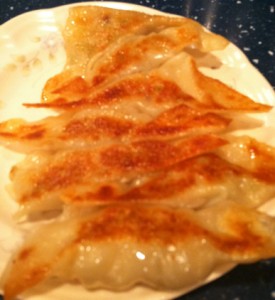
Last night as part of a healthful Asian meal, I made some gyoza (aka potstickers).  Perhaps it wasn’t the most health-conscious move to pan-fry them, but considering the rest of the meal shied away from fat, I didn’t feel that guilty about these crispy, savory submarines.  They are a bit larger and not crimped like I’d normally do gyoza, hence the submarine-like appearance. And yes, I know this is an AWFUL picture, but when you’re doing six other dishes a la minute and you’re starving, your photography can get shoddy.

Chicken and Celery Awoogyoza

The original recipe can be found at Epicurious; I ground up my own chicken thighs into mince and used two stalks of celery.  Like they do in Japan and China, I also added a dash of la-yu (chili oil) to the dipping sauce.